DICOM WSI Slides in the Browser
Open DICOM whole-slide images, as they are. Nothing to convert, nothing to upload. A large slide starts showing right away, because the viewer reads only the part you look at.
A DICOM slide is a folder of .dcm files. Keep them together.
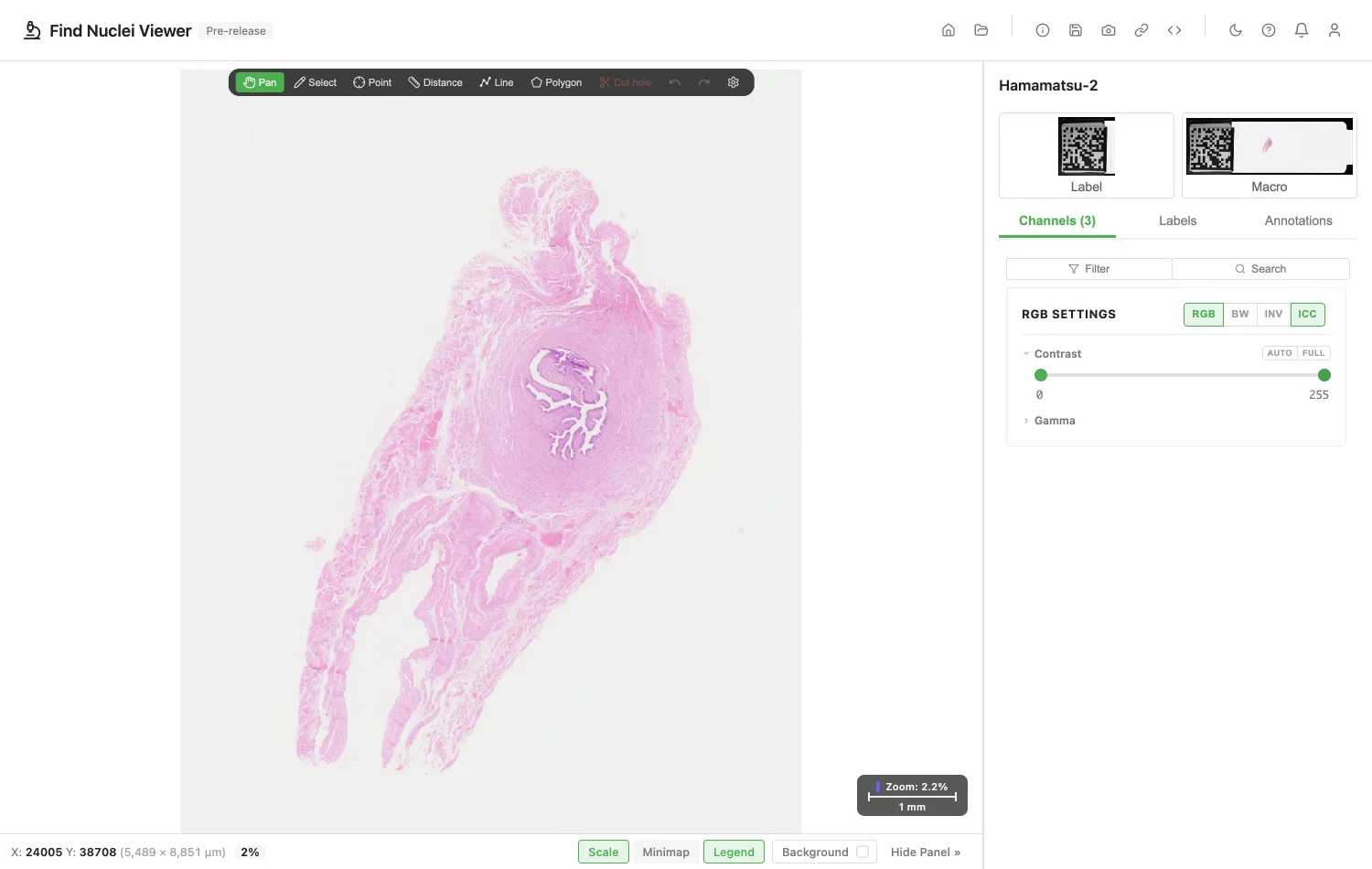
How It Opens
- A folder of
.dcmfiles on your disk, in Chrome and Edge. See Local Files. - One zip made without compression, in any browser, from your disk or its address. See Zip Without Compression.
- An address of the zip:
https://,s3://orgs://. See Remote URLs. - Private data, with a private link or a token. See Private Images and Slides.
What You Will See
- The slide. Zoom from the whole slide down to single cells. Areas the scanner skipped show as white.
- Compression. JPEG, JPEG 2000 and uncompressed.
- Colour profile. A slide that carries its scanner's colour profile is drawn with it. ICC in the RGB settings turns it off. See Channels.
- Label and overview. They appear under the title. A label may show patient details. The viewer shows it and never saves or sends it.
- Patient details. The viewer reads only what it needs to draw the slide. Patient names and IDs are never read.
- Pixel size and magnification. Both come from the slide. When its finest level was resampled, the magnification is left out. Enter it in Pixel Size and Magnification.
If a Slide Does Not Open
The viewer tells you why.
| What the file has | What the viewer says |
|---|---|
| A zip made with compression | The files in this zip are compressed, so they cannot be read in parts. Unzip it and open the folder, or make the zip again without compression (zip -0 -r slide.zip folder). |
| Another compression | This DICOM slide uses a compression the viewer cannot read yet. |
| Not 8-bit RGB | This DICOM slide is not 8-bit RGB. The viewer cannot read it yet. |
| More than one optical path | This DICOM slide has more than one optical path. The viewer cannot read it yet. |
| No slide in the folder | No DICOM slide found here. |
| A damaged or incomplete slide | This DICOM slide looks damaged or incomplete. |
Some DICOM slides open only from your computer, not by address. The viewer tells you when.
Annotations
Import GeoJSON or OME-XML, and export both, from the Annotations panel. Send a link that opens the slide with its annotations. Exchanging Annotations shows how. To draw, measure and label shapes on the slide, see Annotations.
Public Slides to Try
OpenSlide shares test slides in its DICOM folder. Download a slide, then drop it on the viewer. They are CC0. Unpack the zip, or make it again without compression.
For Your IT Team
To open a slide by address, the server must answer byte-range requests and allow them through CORS. For a bucket, allow GET and the Range header in its CORS rules. What the Server Needs has the details.
When a server cannot send parts of a file, the viewer says so. Download the slide and open it from your computer.
Addresses that start with s3:// and gs:// work too.
A DICOM file with no frame table and more than 256 frames opens from disk only. By address it would take one request per frame.
Image credits
The screenshot uses the DICOM slide Hamamatsu-2 from the OpenSlide test data, CC0. See Sample Data and Credits.
Privacy
The slide is read in your browser. Opening one counts as one opened image of the kind "DICOM WSI slide". The file name and address are never recorded. See the privacy policy.
Product names are trademarks of their owners. Find Nuclei is not affiliated with them.